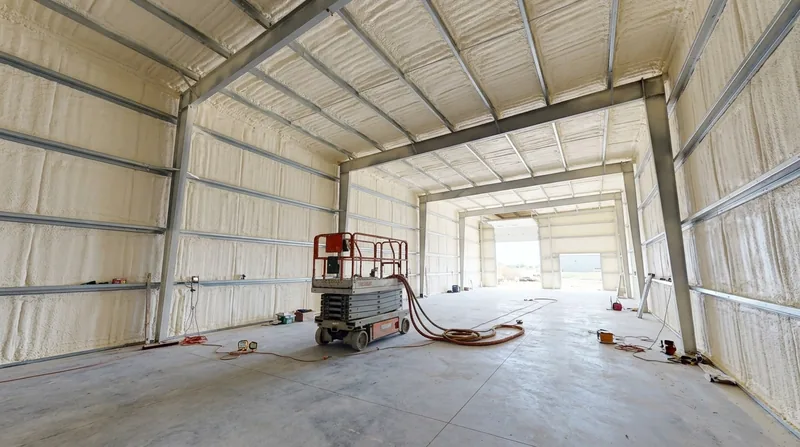




Commercial & New Construction Spray Foam in Wausau is the insulation and air sealing standard for new builds, commercial shells, and retrofit projects across Greater Wausau. The region's business parks, paper mill facilities, and expanding light industrial zones demand thermal control that fiberglass and cellulose cannot reliably deliver, especially in structures with metal framing, open rim conditions, or sealed roof decks exposed to the full swing of Wisconsin's climate. From Weston to Schofield to Marathon County's post-frame farm buildings, spray foam closes the thermal envelope tight, stops condensation at the source, and holds R-value stable across forty-year temperature swings. Whether you are completing a new commercial shell in the Wausau business park, retrofitting a Northwoods cabin over an open crawl space, or sealing a metal building against the frost that creeps in every January thaw, commercial spray foam installation is the method that works. We have been in this trade since 2012, and we know the permitting, the substrate prep, and the mechanical ventilation protocol that separates a sound install from one that leaves a chemical smell hanging for months.
Why Commercial & New Construction Spray Foam Matters in Wausau's Building Climate
Wausau sits on the Wisconsin River where central Wisconsin farm country meets the Northwoods edge, and the climate that defines this region is the reason spray foam has become the insulation of choice for commercial and new construction. Winter temperatures drop to 25 below zero, summer heat peaks at 130 degrees in an unconditioned attic, and the vapor drive that pushes outward most of the year creates condensation at every thermal break. Metal buildings frost inside and drip at every thaw. Sealed roof decks over commercial spaces trap moisture at the sheathing unless the foam is installed with the right density and coverage. New construction that relies on fiberglass batts or blown cellulose leaves gaps at rim joists, band boards, and the transitions between wall and roof that become ice dam factories in January and heat leak zones in July. Spray foam eliminates those gaps, stops air movement cold, and controls the moisture that turns a new commercial shell into a problem property within three years.
- Seals the entire thermal envelope without gaps, stopping air infiltration and exfiltration that fiberglass cannot match.
- Provides continuous R-value across metal studs, rim joists, and roof transitions where batts leave voids and create thermal bridging.
- Controls vapor drive by stopping air movement that carries moisture into insulation and sheathing.
- Holds R-value stable across the 155-degree temperature range from winter to summer that dominates Wausau's climate.
- Eliminates the need for secondary air barriers and vapor retarders that add cost and complexity to new builds.
A correctly installed commercial spray foam system is the only insulation method that reliably performs across new construction, metal buildings, sealed attics, and rim conditions in a climate this severe.
Key info: Wausau's business parks and commercial zones experience ice dam formation, frost buildup on metal framing, and condensation damage in sealed spaces every winter. Spray foam stops ice dams by eliminating the air leaks that warm the roof deck, and it prevents condensation by sealing the substrate before moisture can migrate into the foam. A new commercial shell in Kronenwetter or a metal building retrofit in Rothschild that relies on fiberglass will show visible condensation and frost damage within the first heating season. Spray foam does not.
For more on how sealed insulation systems work in commercial applications, see our guide to closed cell spray foam insulation, the high-density standard for metal buildings and commercial shells.
How We Install Commercial & New Construction Spray Foam: The Wausau Standard
Commercial spray foam installation in Wausau follows a strict protocol: substrate inspection and repair, controlled application with proper drum temperature and ratio, mechanical ventilation during cure, and a documented re-entry window. We do not spray over wet, contaminated, or leaking substrates. We do not promise immediate re-entry. We do not guess at R-value or thickness. Every commercial job begins with a site walkthrough that identifies the vapor source, the substrate condition, the roof or wall assembly, and the permit requirements at that address. We then provide a written estimate that names the foam type (closed cell or open cell), the target R-value, the thickness per pass, and the total board feet. Once the job is scheduled, we arrive with equipment calibrated to the manufacturer's specifications, apply the foam in controlled passes, run mechanical ventilation for the duration of cure plus a safety margin, and provide a re-entry window of 24 to 48 hours before occupancy or drywall installation.
- Inspect the substrate for moisture, contamination, and structural condition, and address any roof leaks, standing water, or damaged sheathing before foam is applied.
- Verify permit requirements with the local building department and confirm whether ignition barriers, thermal barriers, or ventilation specifications apply to your address.
- Set up mechanical ventilation on the space to be sprayed and confirm airflow with the installer before application begins.
- Apply foam in controlled thickness passes, maintaining manufacturer ratio and drum temperature throughout the job.
- Continue mechanical ventilation for the full cure period plus a safety buffer, typically 24 to 48 hours.
- Document R-value, thickness, board footage, and re-entry window in writing, and provide a copy to the building owner and the permit holder.
This process is standard for any spray foam contractor who understands the trade, and it is the only process that produces a reliable, code-compliant result in Wausau's climate.
Example: A new commercial shell in the Wausau business park is framed with metal studs and metal roof decking. The contractor has called in a spray foam crew to seal the roof deck and rim joists before drywall and HVAC installation. We arrive with the building sealed and mechanical ventilation running. We apply closed cell foam to 2.5 inches over the entire deck, achieving R-18 and stopping vapor drive at the sheathing. We run ventilation for 36 hours, document the coverage, and sign off on re-entry. The building is dried in, drywall goes up on schedule, and the sealed thermal envelope is ready for occupancy. No condensation, no ice dams, no post-construction problems.
For detailed information on our approach to air sealing and thermal envelope closure, visit our air sealing page.
Commercial & New Construction Spray Foam Methods and Applications
| Method | Description | Best For |
|---|---|---|
| Closed Cell Foam (2 lb density) | High-density spray foam with closed cell structure. Achieves R-6.5 to R-7 per inch. Low permeability stops vapor and air movement. Requires ignition barrier in most code zones. | Metal buildings, sealed roof decks, rim and band joists, crawl spaces with moisture, commercial shells requiring high R-value in minimal thickness. |
| Open Cell Foam (0.5 lb density) | Lower-density spray foam with open cell structure. Achieves R-3.5 to R-3.8 per inch. Vapor-permeable, allows drying to interior. Lower cost per board foot. Requires thermal barrier in most code zones. | Interior walls, attics with good ventilation, sound dampening in new construction, cost-sensitive commercial retrofit where moisture control is secondary. |
| Rim and Band Joist Sealing | Closed cell foam applied to the band joist and rim area where the foundation meets the floor frame. Stops air leaks and thermal bridging at the building perimeter. Typically 2 to 3 inches thick. | New commercial construction, basement rim retrofit, buildings over crawl spaces, any structure where basement rim is exposed to outdoor temperature swings. |
| Sealed Roof Deck Systems | Closed cell foam applied to metal or wood roof decking to create an unvented, conditioned attic or roof cavity. Foam acts as both insulation and air barrier. Thickness and density determined by climate and code zone. | New commercial construction, metal building retrofit, any roof assembly where traditional vented attic is not feasible or where vapor control is critical. |
| Wall Cavity Injection | Closed cell or open cell foam injected into existing wall cavities through holes drilled from interior or exterior. No demolition required. Fills all voids and seals air leaks within the wall assembly. | Commercial retrofit of existing walls, historical buildings, new construction walls where cavity fill is preferred over surface application, any wall where retrofit is required without framing exposure. |
Commercial & New Construction Spray Foam Cost in Wausau: What to Expect
Spray foam pricing for commercial and new construction projects depends on the scope of work, the foam type, the target R-value, the substrate condition, and the accessibility of the space. A free commercial estimate is the only realistic starting point, because the cost difference between a small rim joist sealing and a full sealed roof deck over a 10,000-square-foot commercial shell is measured in thousands of dollars and board feet. We provide written estimates that specify the foam type, the thickness per pass, the total R-value, the board footage, and the labor and material cost broken down by zone or application. Factors that move the price up include larger square footage, higher target R-values, difficult access (high roofs, tight crawl spaces, confined commercial interiors), metal framing that requires more passes to seal gaps, and any substrate prep or moisture remediation needed before foam is applied.
For detailed pricing guidance and a realistic range for your project size and foam type, see our full pricing overview. Call (534) 901-1691 for a free commercial estimate, or visit our contact page to request an on-site walkthrough. We respond within 24 hours and provide a written quote with no obligation to book.
Commercial & New Construction Spray Foam Near Me: What to Look for When Hiring a Contractor in Wausau
Choosing a spray foam contractor for commercial or new construction work in Wausau requires verification of insurance, a clear understanding of the estimate, and confirmation that the contractor understands the permitting and code requirements at your specific address. The insulation trade has two extremes: rig-and-run crews that spray a job in an afternoon with no ventilation and no re-entry window, and national franchises with pricing that does not reflect local market conditions. The local independent contractor who maintains insurance, provides written estimates with R-value and thickness specifications, and knows the Marathon County and City of Wausau building codes is the middle ground and the safest choice. Ask any potential contractor for proof of current insurance, request references from recent commercial jobs, and verify that they understand whether permits are required at your address and what the local building department requires in terms of ignition barriers, thermal barriers, or ventilation specifications. Do not accept an estimate with no R-value, no thickness, and no board footage. Do not accept a price far below market with no inspection or documentation. Do not accept a promise of immediate re-entry or a claim that the work is complete before ventilation has finished.
- Request a written estimate that names the foam type, the target R-value, the thickness per pass, the total board feet, and the labor and material cost.
- Ask for proof of current insurance and request references from at least two commercial projects completed in the past two years.
- Confirm with the local building department whether permits are required and what specifications apply to your address.
- Verify that the contractor plans to run mechanical ventilation during cure and will provide a documented re-entry window of 24 to 48 hours.
- Ask how the contractor handles substrate prep and whether they walk away from wet, contaminated, or leaking substrates.
A contractor who can answer these questions clearly and provide documentation is one who understands the trade and will deliver a reliable result.
To discuss your commercial or new construction project and receive a free estimate, contact us today or call (534) 901-1691.
Commercial & New Construction Spray Foam in Wausau: Pricing Guide
| Service | Price | Details |
|---|---|---|
| Free commercial estimate | Free | On-site walkthrough with substrate inspection, code verification, and written quote with R-value and thickness specifications |
| Closed cell foam (sealed roof deck or rim joist) | Starting at $2.50 per board foot | High-density foam for metal buildings, sealed attics, and commercial shells where vapor control is critical |
| Open cell foam (interior walls, attics) | Starting at $1.25 per board foot | Lower-density foam for cost-sensitive commercial retrofit and new construction where vapor permeability is acceptable |
| Substrate prep and moisture remediation | On estimate | Repair of roof leaks, drainage correction, or structural prep required before foam can be safely applied |
| Mechanical ventilation and cure time | Included | Full ventilation during application and cure period plus 24 to 48 hour re-entry window documented in writing |
| Travel and mobilization | Included | No separate mileage fee or call-out charge for jobs in Wausau, Weston, Schofield, Rothschild, and surrounding service areas |
Indicative pricing, the exact cost depends on square footage, finish, and site access. Free personalized estimate within 24h at (534) 901-1691.


