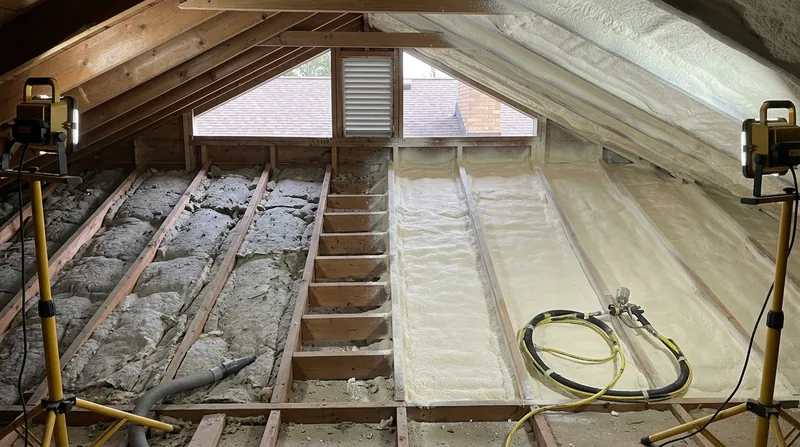




Wausau homes built from the 1880s through the 1970s were insulated with materials that fail predictably: cellulose settles and compacts, fiberglass loses R-value when wet, and older foam systems yellow and off-gas. The climate here drives the failure: attics swing from 130 degrees Fahrenheit in July to 25 below in January, ice dams form every winter, and vapor pressure pushes outward through nine months of the year. When insulation stops working, energy bills climb, condensation appears in rim joists and crawl spaces, and the house becomes harder to condition. Insulation Replacement & Re-Insulation in Wausau means removing what failed and installing spray foam or blown-in material that actually holds its R-value, stops air leaks, and handles the moisture load that Wisconsin winters and springs demand. We remove old insulation, seal air bypasses, and install new material to code with written specifications for thickness and R-value. The work pays for itself in lower heating and cooling bills, fewer ice dams, and a house that stays dry.
Why Insulation Replacement Matters in Wausau's Four-Season Climate
Wausau sits on the Wisconsin River where the Northwoods climate meets central Wisconsin farm country. The city's residential stock runs from 1880s balloon-framed Victorians in the Andrew Warren district to 1940s-1970s story-and-a-half homes and ranches on the West Side and North Side, plus 1990s-2020s two-stories and heated garages in Weston, Rib Mountain, and Kronenwetter. Every home built before 1990 was insulated with materials engineered for a gentler climate than what Wausau actually gets: heavy snow, long stretches below zero, and vapor drive that pushes moisture outward through most of the year. When that insulation settles, compacts, or absorbs moisture, it stops working. The result is ice dams that back water into walls, higher heating bills, and condensation that rots rim joists and basement band boards.
- Cellulose and mineral wool insulation compact over time, losing R-value and leaving air gaps where heat escapes.
- Fiberglass batts absorb moisture from basement humidity and crawl space vapor, reducing thermal resistance by 20 to 30 percent.
- Older polyurethane foam systems yellow, off-gas, and fail when exposed to temperature swings and UV light.
- Air leaks around rim joists, band boards, and attic bypasses account for 30 to 40 percent of heating loss in older homes.
- Ice dams form when heat escapes through poor attic insulation, melting snow on the roof and backing water into the house.
Replacing failed insulation with spray foam or modern blown-in material stops these failure modes at the source. Spray foam seals air leaks as it insulates, so you get both R-value and air tightness in one step. For attics, crawl spaces, and rim joists in Wausau's climate, that combination is what actually works.
Local example: A 1950s ranch in Schofield with a knee-wall attic and fiberglass that had settled to R-8 in the peak areas was losing $200 a month to heating bills in January. After removal and closed-cell foam replacement to R-38, heating costs dropped 35 percent and the ice dam that had appeared every March stopped forming. The rim joist and basement band board, which had begun to show moisture staining, dried out completely within one heating season.
Refer to our insulation removal page for details on how we extract old material safely before the new insulation goes in.
How Insulation Replacement Works: Step-by-Step in Wausau Homes
The process begins with a walkthrough and estimate. We identify what insulation is in place, measure its depth and condition, check for air leaks and moisture, and recommend either full replacement or a targeted top-up. In Wausau, most jobs are full replacements: old fiberglass or cellulose comes out, the space is cleaned, air leaks are sealed, and new spray foam or blown-in insulation is installed. The work is interior, so weather and season matter less than they do for roofing or exterior work. Winter and spring are actually ideal in Wausau because homeowners feel the heating loss most acutely then and want the job done before next winter.
- We provide a written estimate with R-value, thickness, and square footage specified for your attic, crawl space, or rim joist area.
- We remove old insulation, bag it, and haul it away. If the old material looks like vermiculite, we stop and do not disturb it until it has been tested by a specialist.
- We seal air leaks around rim joists, band boards, attic bypasses, and ductwork with closed-cell foam or caulk before we insulate.
- We install new spray foam (closed cell for maximum R-value and moisture control, open cell for cost-effective attic insulation) or blown-in mineral wool to the specified depth.
- We verify thickness and coverage on-site and provide a final inspection report with photographs and R-value documentation.
The timeline depends on scope. A 1,200-square-foot attic replacement typically takes one day of work, plus one day for cure if spray foam is used. Crawl spaces and rim joists are smaller jobs, often completed in a morning or afternoon. We schedule around your calendar and your contractor's timeline if other work is happening.
Real example: A 1960s split-entry in Rothschild had mineral wool insulation in the attic and fiberglass batts in the rim joist. The homeowner wanted the attic upgraded to R-38 and the rim joist sealed to stop condensation in the basement. We removed both, sealed air leaks around the attic hatch and ductwork, installed closed-cell foam in the rim joist (which also acts as an air barrier), and blown-in cellulose in the attic. The job took two days and cost less than spray foam would have for the attic alone, because blown-in was the right material for that application.
For more on the technical details of closed-cell spray foam and when to use it, see our closed-cell page.
Insulation Replacement Methods: Spray Foam, Blown-In, and Hybrid Approaches
| Approach | Description | Best for |
|---|---|---|
| Closed-Cell Spray Foam | High-density foam applied at 1.5 to 2 pounds per cubic foot, cures to R-7 per inch, creates a continuous air barrier and vapor retarder. | Rim joists, band boards, crawl spaces, sealed attics, and basement walls where moisture control and maximum R-value in minimal space are priorities. |
| Open-Cell Spray Foam | Low-density foam applied at 0.5 pounds per cubic foot, cures to R-3.6 per inch, allows vapor transmission and sound dampening. | Attics where ventilation is required, interior walls, and garages where cost efficiency and sound control matter more than maximum R-value. |
| Blown-In Cellulose or Mineral Wool | Loose-fill insulation installed with a blower to fill cavities and attic floors, R-value ranges from R-3.2 to R-3.8 per inch depending on density and material. | Attics with adequate ventilation, wall cavities in retrofit work, and jobs where the lowest material cost and fastest installation time are required. |
| Hybrid (Foam + Blown-In) | Closed-cell or open-cell foam seals air leaks and critical areas, then blown-in insulation tops up the R-value at lower cost. | Attics where air sealing is essential and cost matters, crawl spaces with rim joists, and mixed applications like a finished basement wall plus attic floor. |
The right method depends on the space, your budget, local code requirements, and whether ventilation is needed. In Wausau's climate, rim joists and crawl spaces almost always need closed-cell foam because vapor control and condensation prevention are non-negotiable. Attics are more flexible: if ventilation is required by code, blown-in or open-cell foam works. If the attic is sealed (which newer codes increasingly allow), closed-cell foam gives you the best long-term performance. We help you understand what applies at your address and what makes economic sense for your house.
Insulation Replacement & Re-Insulation Cost in Wausau: What to Expect
The cost of insulation replacement depends on the area being insulated, the material chosen, and the condition of the space before work begins. An attic replacement in Wausau typically starts around $2,800 to $4,200 for a 1,200-square-foot area, depending on whether you choose blown-in cellulose (lower cost, adequate for ventilated attics) or spray foam (higher cost, better air sealing and moisture control). Rim joist and band board work runs $1,200 to $2,500 per 100 linear feet, depending on access and whether the space needs moisture remediation first. Crawl space insulation and air sealing is priced per square foot and typically ranges from $3,500 to $6,000 for a full 1,000-square-foot crawl space, because the work includes not just insulation but also air sealing and sometimes substrate preparation.
Several factors move the cost up or down. Access to the space matters: an attic with a full-size door and safe walkways is cheaper to work in than a cramped knee-wall attic or a space with low headroom. The condition of the existing insulation affects removal costs: if the old material is damp or contaminated, removal takes longer and may require specialized handling. The thickness and R-value you choose make a difference: R-38 in an attic costs less per square foot than R-49 because it requires fewer inches of material. And the material itself: blown-in cellulose is the lowest-cost insulation, open-cell spray foam is mid-range, and closed-cell foam is the highest cost because of its superior R-value per inch and moisture resistance.
We provide a written estimate before any work begins. The estimate includes the square footage or linear footage of the area, the R-value and thickness we recommend, the material type, and the total cost with no hidden fees. Travel within Wausau and surrounding service areas is included. If you want to compare options, we can show you the cost difference between blown-in and spray foam, or between R-38 and R-49, so you can make an informed choice. For a detailed pricing breakdown and to discuss your specific space, see our pricing overview or call us at (534) 901-1691 for a free estimate.
Insulation Replacement & Re-Insulation Near Me: What Wausau Homeowners Should Know Before Hiring
When you hire a spray foam or insulation contractor, verify that they are fully insured and carry workers' compensation coverage. Ask for a certificate of insurance and call the insurance company to confirm the policy is active and covers the specific work you need. Get written estimates from at least two contractors so you can compare not just price but scope, material choices, and R-value specifications. A good estimate names the material type (e.g., closed-cell foam, open-cell foam, blown-in cellulose), the thickness in inches, the R-value per inch and total R-value, the square footage or linear footage, and the labor and material costs separately. If an estimate has no R-value, no thickness, and no breakdown, walk away.
Ask each contractor about permits and code compliance. Attic ventilation, thermal barriers, and ignition barriers are governed by the building code in force at your address and by your local building official. Wausau, Weston, Schofield, Rothschild, and other cities in Marathon County have different code officials and permitting processes, so there is no one-size-fits-all answer. A contractor who says "we always vent" or "we never vent" is not thinking about your specific house and code. The right answer depends on the existing condition, the new insulation type, and what your building official requires. Ask the contractor to walk you through what applies at your address and to explain why.
- Confirm that the contractor uses a mechanical ventilation system during spray foam cure to manage odor and off-gassing, and ask about the re-entry window (typically 24 to 48 hours).
- Check references from homeowners in Wausau or nearby towns who have had similar work done, and ask about the quality of the finish, the timeline, and whether there were any issues after the job was complete.
- Verify that the contractor holds a current business license in your city or town; licensing and registration vary by municipality in Wisconsin, so confirm what applies where you live.
- Ask whether the contractor will handle permits or help you understand what you need to apply for; permitting is your responsibility, but a good contractor will explain what applies at your address.
- If your home is in an HOA or a historic district like the Andrew Warren area, check whether architectural review is required for exterior work or visible changes; insulation is usually interior and exempt, but verify with your HOA or historic commission first.
A contractor who gives you a clear estimate, explains the code requirements that apply to your house, provides references, and carries insurance is someone you can trust. For a free estimate from our team, contact us online or call (534) 901-1691. We have been in business since 2012 and serve Wausau, Weston, Schofield, Rothschild, Rib Mountain, Kronenwetter, and the surrounding area.
Insulation Replacement & Re-Insulation in Wausau: Pricing Guide
| Service | Price | Details |
|---|---|---|
| Attic Insulation Replacement | Starting at $2,800 | 1,200 sq ft attic with removal and blown-in cellulose to R-38 or R-49 installed |
| Rim Joist & Band Board Sealing | Starting at $1,200 | 100 linear feet of closed-cell foam air sealing and insulation with substrate prep included |
| Crawl Space Insulation & Air Sealing | Starting at $3,500 | 1,000 sq ft crawl space with closed-cell rim joist foam, band board sealing, and floor insulation |
| Full Home Energy Retrofit (Attic + Rim + Crawl) | On estimate | Multi-area project requires site visit to assess removal scope, moisture, and access before quote |
| Travel & Estimates | Included | No mileage fees or travel charges within Wausau and surrounding Marathon County service area |
| Free Estimate | Free | Written estimate with R-value and thickness specs provided within 24 hours, no obligation to book |
Indicative pricing, the exact cost depends on square footage, finish, and site access. Free personalized estimate within 24h at (534) 901-1691.


